Service Area Pages & Answer-First Content That AI Engines Love to Cite
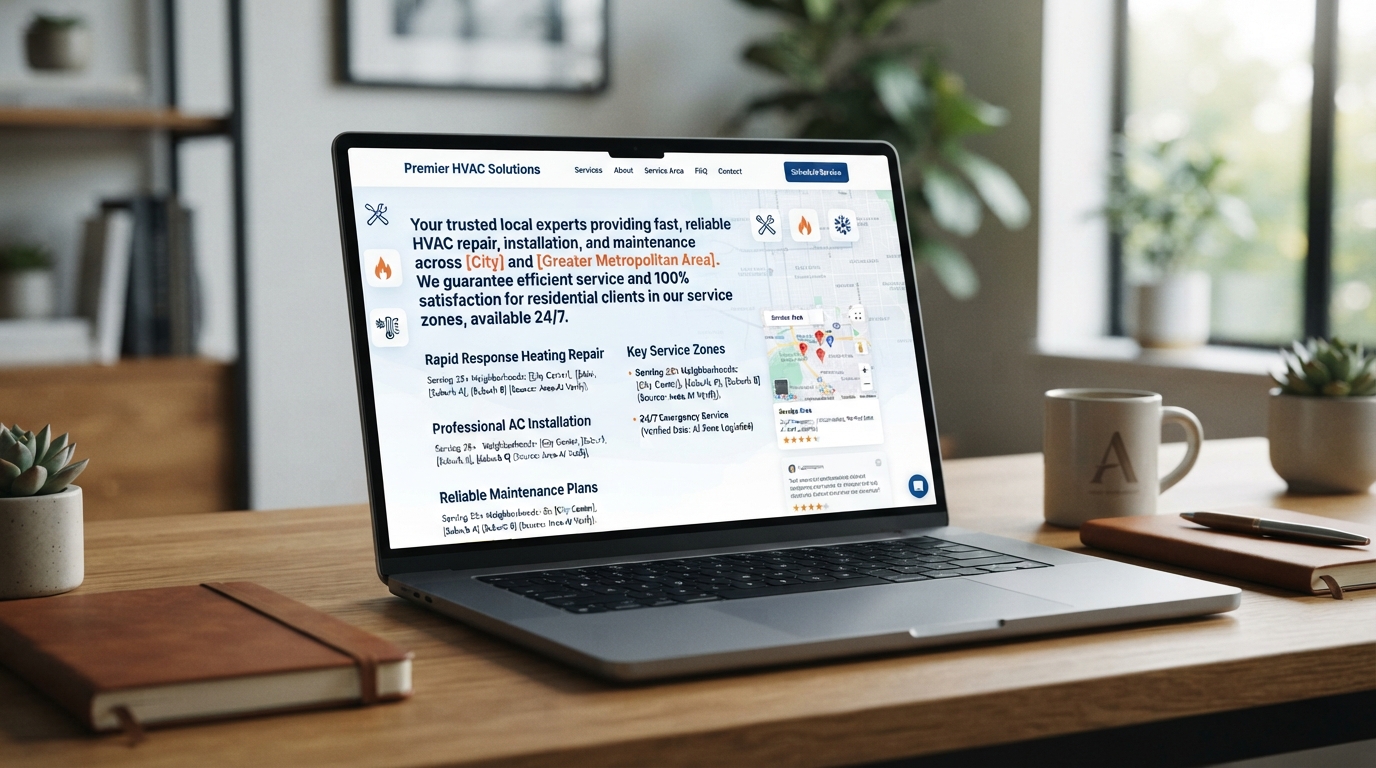
How to structure pages so ChatGPT, Perplexity, and Google AI Overviews can extract clean, citable passages — practical template for plumbers, HVAC, roofers, and local trades.
Table of Contents
- Why Most Service Area Pages Fail AI Extraction
- What "Answer-First" Content Actually Means for AI Citations
- The Ideal Structure for a Citable Service Area Page
- How Long Should the Opening Answer Be (and What It Must Include)
- Unique Local Detail vs. Thin Template Pages — What Works
- Supporting Elements That Make Passages Easy to Extract
- In My Experience: Turning Generic City Pages into AI-Cited Assets
- Step-by-Step Implementation for Busy Trade Owners
Why Most Service Area Pages Fail AI Extraction
Traditional local SEO rewarded having a page for each city or neighborhood. Many businesses responded with thin pages that swapped the city name and little else. Those pages may still rank for some Google queries, but they rarely produce the extractable units that ChatGPT, Perplexity, or Google AI Overviews prefer to cite.
When the core answer is buried under marketing fluff, or every city page is nearly identical, the model has no high-confidence passage to quote. The result is silence — your business is simply not named.
What "Answer-First" Content Actually Means for AI Citations
2026 research on answer-first structure shows measurable citation lifts. Pages that lead with a clear, declarative answer are cited more frequently than pages that open with background, stories, or soft marketing language. Models pull disproportionately from the early portion of a page and from the first sentences after a heading.
The practical rule is simple: every H2 should begin with a short, self-contained answer to the question the heading implies. No "In today's competitive market…" or "When homeowners in [city] need…" openings. State the fact or recommendation first, then expand.
The Ideal Structure for a Citable Service Area Page
| Section | Purpose for AI Extraction | Key Rule |
|---|---|---|
| H1 + Opening Answer | Immediate, quotable definition of service + area | 40–60 words max, no fluff |
| What We Do in [City] | Scoped deliverables and process | Self-contained list or short paragraphs |
| Local Context / Proof | Neighborhood-specific or city-specific detail | Unique facts, not generic claims |
| FAQ Block | Direct Q&A pairs models love to lift | Visible on page + FAQPage schema |
| Schema | Machine-readable entity and service signals | LocalBusiness/Service + areaServed |
This structure works for both pure service-area businesses and multi-location companies that need city-specific pages.
How Long Should the Opening Answer Be (and What It Must Include)
Strong opening example (HVAC):
"Summit Heating & Cooling provides same-day residential AC repair and replacement throughout Denver and the surrounding metro area. Our NATE-certified technicians handle emergency breakdowns, seasonal tune-ups, and full system installations with transparent pricing and a clear diagnostic process."
Weak opening (avoid):
"When the summer heat hits Denver, homeowners know they need a reliable partner they can trust. At Summit Heating & Cooling we have been proudly serving the community for years and understand the unique challenges of Colorado's climate…"
The strong version can be lifted almost verbatim. The weak version forces the model to dig or skip the page.
Unique Local Detail vs. Thin Template Pages — What Works
Thin template pages signal low value. Useful local detail does the opposite. Examples that increase extractability:
- Common issues in older neighborhoods (e.g., "Many homes in [neighborhood] still have original galvanized supply lines that fail after 40–50 years")
- Local climate or code considerations
- Specific response times or service commitments for that city
- Short, real project outcomes from that area (without fabricating claims)
Aim for at least several hundred words of unique, useful content per major service-area page. If you cannot add real local substance, it is better to have fewer strong pages than dozens of thin ones.
Supporting Elements That Make Passages Easy to Extract
Headings: Prefer question or clear declarative H2s ("How much does emergency AC repair cost in Denver?" or "What our Denver AC repair service includes").
Paragraphs: Keep them short (two to three sentences). Long blocks are harder to chunk cleanly.
Lists and tables: AI engines extract structured formats reliably. Use them for process steps, inclusions, or pricing ranges when appropriate.
FAQ section: Real customer questions answered in plain language, marked up with FAQPage schema, and visible on the page.
Schema: LocalBusiness (or subtype) with accurate areaServed, plus Service schema on the page, and FAQPage where FAQs exist. Match the structured data to the visible content.
In My Experience: Turning Generic City Pages into AI-Cited Assets
The biggest jump comes from rewriting the first 60 words of every major service-area page and adding one or two genuinely local details. Owners who treated city pages as an SEO checkbox often saw little AI visibility. Those who rewrote openings to be answer-first and added neighborhood-specific context began appearing in more targeted prompts. The pages did not need to be long — they needed to be clear, unique, and easy to quote. Pairing that structure with solid schema and consistent entity data compounds the effect.
Step-by-Step Implementation for Busy Trade Owners
- Identify your top 5–10 service-area or city pages by traffic or lead volume.
- Rewrite the opening 40–60 words of each so the answer is immediate and self-contained.
- Add at least one unique local detail (neighborhood issue, response commitment, or real local context).
- Convert key sections to short paragraphs or lists and ensure every H2 starts with a direct answer.
- Add or expand a visible FAQ section with real questions and implement FAQPage schema.
- Confirm LocalBusiness/Service schema includes accurate areaServed values.
- Validate the page and re-test relevant prompts in ChatGPT, Perplexity, and Google.
- Repeat for the next tier of pages. Measure progress with the free NSiTZ AI Readiness Scan.
Well-structured service area pages become reliable sources that AI engines can cite. When those citations generate inquiries, a 60-second automated response system ensures the lead is captured and converted instead of lost to the next company on the list.
Make Your Service Area Pages Citable
Apply the answer-first structure above, strengthen your entity signals, and connect better AI visibility to actual booked jobs with a system built for trades.
Get Your Free AI Readiness Scan Book a Free Demo See How NSiTZ WorksRelated resources: Lead Loss Calculator · Pricing · House Cleaning Systems · Landscaping Automation
Tags:
Want these results for your business?
Let's build a custom automated follow-up system for your operation.
Book a Free Strategy CallRelated Articles