Stop Losing Septic Leads to Voicemail & Slow Follow-Up
Response-time pressure, 80%+ voicemail abandonment, after-hours volume, and open-quote leakage are quietly draining septic companies. Here's the data — and what changes when every lead gets a 60-second response.
Table of Contents
- Why Do Most Septic Callers Hang Up on Voicemail?
- How Much After-Hours Volume Are Septic Companies Actually Missing?
- What Happens to Open Quotes That Never Get Followed Up?
- How Fast Does Response Time Actually Move the Needle?
- In My Experience Working with Service Businesses
- What Does a 60-Second Automated System Change for a Septic Operator?
- How Do You Capture the Leads You're Already Paying For?
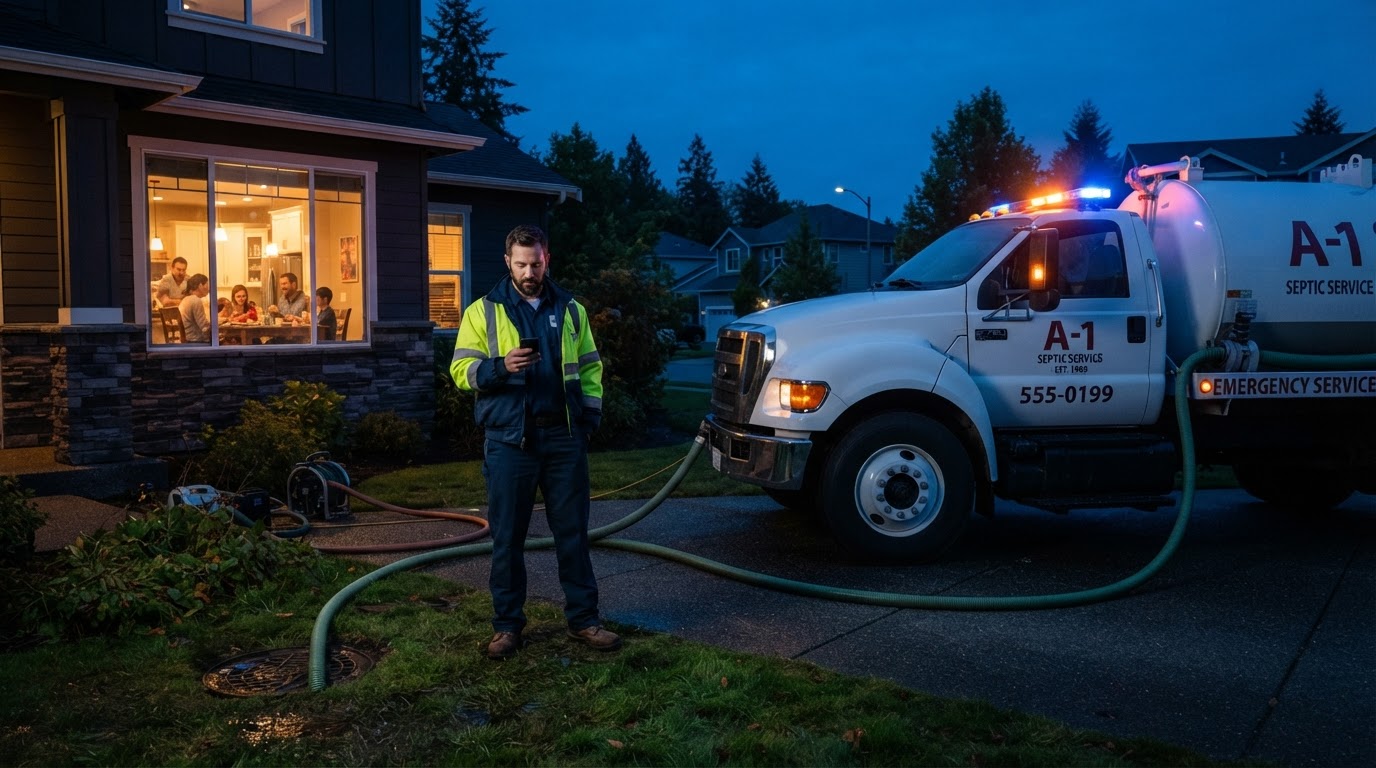
Imagine this scene. It's 7:40 p.m. You're finally sitting down to dinner with your family after a full day of pumping tanks and crawling under houses. Your phone lights up. A homeowner has sewage backing into the basement. They're frantic. You silence the call because you're mid-bite and already exhausted. By the time you check the voicemail an hour later, they've already dialed the next three companies on Google. One of them answered. The job is gone.
That moment is not rare. It is the daily reality for most septic service companies. The industry content and related searches keep surfacing the same pressure points: response-time pressure, voicemail abandonment, after-hours volume, and open-quote leakage. These are not abstract marketing stats. They are the exact reasons septic operators lose high-value emergency work and high-ticket installs while working longer hours than ever.
In this piece we go deeper than the surface numbers. We look at what the data actually shows, why the leakage is so persistent in septic work, and what changes when a done-for-you system answers and follows up in 60 seconds — so the business serves your life instead of owning it.
Why Do Most Septic Callers Hang Up on Voicemail?
Homeowners calling about a septic backup or slow drains are not browsing. They are dealing with a problem that can damage floors, create health risks, and keep them from using their own bathrooms. When the call goes to voicemail, most do not leave a message and wait. Industry platform data consistently shows that fewer than 3% of callers pushed to voicemail leave a message, and broader contractor analyses put the hang-up rate in the 80–86% range.
A septic-specific breakdown from operators and lead-capture platforms lands in the same place: when a homeowner calls about pumping or an emergency and hits voicemail, approximately 80% hang up and call the next company. They do not leave a callback number. They do not try again the next morning. The lead disappears.
This is not because people are rude. It is because the alternative is one thumb-tap away. Google shows a list of local septic companies. The first one that answers wins a large share of the work. The rest never even know the call happened.
For a company receiving 50–60 inbound calls a month and missing even 25–35% of them, that is 12–20 potential jobs vanishing every month. At typical residential pumping tickets of $300–$600 (and higher for emergency or repair work), the monthly leakage quickly reaches several thousand dollars — before you count the higher-ticket installs that also walk.
How Much After-Hours Volume Are Septic Companies Actually Missing?
Most septic companies still operate on a daytime phone model. The trucks roll during business hours. The phone is answered when someone is in the office or between jobs. Yet the data on when people actually call tells a different story.
Across home services, platform and industry analyses repeatedly show that 35–40% of calls come outside standard business hours. Broader service-business reports place the range at 35–45%. For trades with true emergencies — plumbing, HVAC, and septic — the evening and weekend share is often at the high end of that range. A sewage backup does not wait for 8 a.m. Monday. A full tank discovered when the family gets home from work does not politely hold until morning.
The result is predictable. The highest-urgency, often highest-margin calls hit voicemail. The homeowner moves on. The company that answered — sometimes an answering service, sometimes a competitor with better coverage — books the job and builds the reputation for reliability.
Seasonal spikes make the gap worse. Spring and summer maintenance demand, freeze events, and heavy rain all push more volume into evenings and weekends. Companies without after-hours capture simply absorb the loss while competitors who answer build market share.
What Happens to Open Quotes That Never Get Followed Up?
Missed calls are the most visible leak. Open quotes are the quieter one. A homeowner requests a price for a pump-out, a repair, or a full system replacement. You or your tech put a number together. The quote goes out — or sometimes sits in a folder. Then silence.
Contractor-wide data shows that a large share of quotes either never get sent or receive little to no follow-up. Close rates without a system sit far lower than close rates with consistent, timely touches. One septic-focused analysis places the open-quote leakage at 40–60%. That range is consistent with broader trade surveys that find many estimates die from inaction rather than from price or competition.
The math is straightforward and painful. A modest pipeline of 15–20 open quotes a month at average values of $1,500–$8,000 (common for repairs and installs) creates tens of thousands of dollars in potential revenue. When 40–60% of that pipeline goes cold because no one followed up at 48 hours, one week, or two weeks, the lost opportunity compounds quietly every month.
Most septic owners know this is happening. Few have a reliable system that automatically sequences the follow-up without requiring the owner or office staff to remember and execute it after a long day in the field.
How Fast Does Response Time Actually Move the Needle?
Speed is not a soft preference. It is the dominant variable in lead conversion for local service businesses. The classic MIT/InsideSales research popularized by Harvard Business Review found that firms contacting a lead within five minutes versus thirty minutes were far more likely to reach the prospect and to qualify the opportunity. The multipliers commonly cited are on the order of 100× for contact rate and 21× for qualification rate when comparing the five-minute window to a thirty-minute delay.
In the septic context the principle is even sharper. A homeowner with sewage in the basement is not evaluating multiple proposals over several days. They are looking for the first competent company that picks up and can give a realistic arrival window. Platform data and operator reports align: the first responder captures a large majority of emergency work.
| Response Window | Relative Likelihood of Meaningful Contact / Qualification | Practical Septic Outcome |
|---|---|---|
| Under 5 minutes | Baseline highest (21× vs 30-min window in classic study) | First-call advantage; high chance of booking emergency |
| 5–30 minutes | Sharp drop | Many leads already speaking with a competitor |
| 1–4 hours | Further steep decline | Most emergency work already booked elsewhere |
| Next business day | Near-zero for urgent needs | Lead is cold; recovery rare |
The Harvard Business Review summary of the underlying research and the consistent platform observations make the same point: speed is the competitive advantage that is still under-used by most septic operators.
I have watched capable septic owners lose the same pattern of jobs for years. They are excellent technicians. They show up, do clean work, and treat customers fairly. Yet the phone system and follow-up process never matched the quality of the fieldwork. The owner ends up living on the phone after hours, or simply accepting that a large slice of inbound demand will go to whoever answers first. The moment we put a reliable 60-second capture and follow-up layer in place, two things happen: the emergency jobs start sticking, and the owner's evenings start belonging to the family again. That combination — more revenue and more life — is what keeps owners in the game long term.
What Does a 60-Second Automated System Change for a Septic Operator?
The practical shift is simple but powerful. Instead of hoping the right person is free to answer, or racing to return a voicemail after the fact, an automated layer responds in roughly 60 seconds. It can answer common questions, capture the essential details, book available slots when appropriate, and escalate true emergencies to the on-call tech with full context.
For after-hours volume the change is especially clear. The 30–40% of calls that previously hit dead air or a generic recording now receive a competent first response. Many of those callers book or at least stay engaged instead of dialing the next number.
For open quotes the same system can run a simple, consistent sequence: same-day thank-you, 48-hour check-in, one-week nudge. No one has to remember. The recoverable portion of the 40–60% leakage starts coming back without extra mental load on the owner.
The lifestyle difference is the part most owners underestimate until they feel it. You can finish a job, drive home, and sit down to dinner without the low-level dread that the next emergency call is already going to a competitor. You can take a real weekend or a short vacation knowing the inbound side is still covered. The business begins to serve your life rather than the other way around.
How Do You Capture the Leads You're Already Paying For?
You do not necessarily need more leads. You need to stop leaking the ones that are already coming in. That means:
- Immediate acknowledgment of every phone call and form submission
- After-hours coverage that does not rely on the owner living on the phone
- A reliable quote follow-up sequence that runs without daily willpower
- Clear hand-off of qualified emergencies to the right technician with context
The EPA reminds homeowners that regular maintenance every three to five years prevents expensive failures that can run $5,000–$15,000 or more. The same principle applies to the business side: a small, consistent system for lead response and follow-up prevents the expensive leakage of jobs you have already paid to attract.
When the system is in place, the numbers shift. Missed-call leakage drops. After-hours volume becomes revenue instead of frustration. Open quotes start converting at higher rates. And the owner finally gets the breathing room that makes the whole operation sustainable.
If you are ready to stop losing the jobs that are already calling you, the next step is simple. See exactly how a done-for-you 60-second automated lead follow-up system works for septic and other local service businesses.
Ready to Capture More of the Leads You're Already Paying For?
See how NSiTZ's done-for-you 60-second automated system handles missed calls, after-hours volume, and quote follow-up — so you can focus on the work and still have evenings and weekends.
See How It Works View Pricing Book a Free Demo CallThe patterns described here — high voicemail abandonment, substantial after-hours volume, and significant open-quote leakage — are repeatedly observed across home-service call-tracking platforms and operator reports. Exact percentages vary by market and season, but the direction and magnitude are consistent. Always pair any system change with your own call data for the clearest picture.
Tags:
Want these results for your business?
Let's build a custom automated follow-up system for your operation.
Book a Free Strategy CallRelated Articles