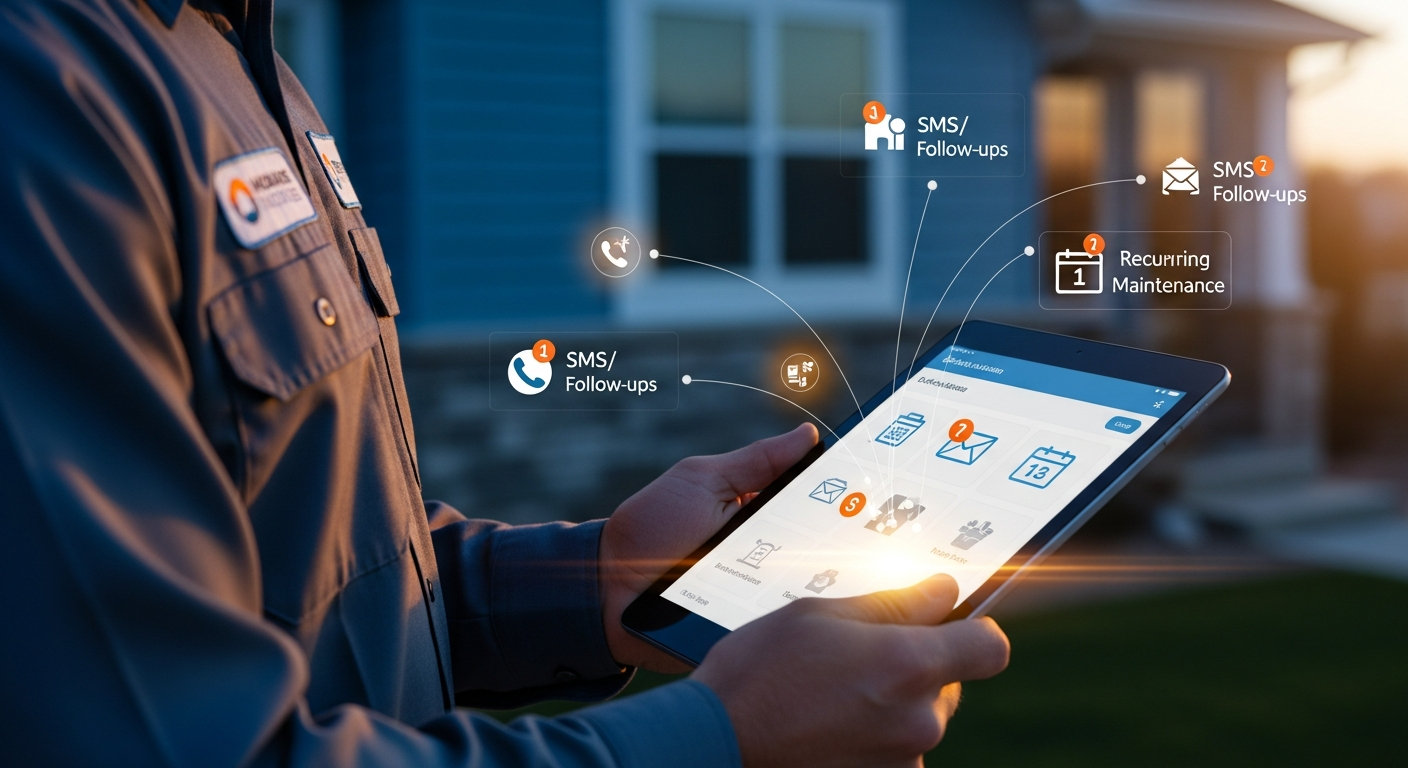
From Lead to Loyal Client: Multi-Touch Automation for HVAC Businesses
NSiTZ Team
July 1, 2026
Share:
Stop losing high-value HVAC jobs to faster competitors. Discover how automated multi-touch sequences turn inquiries into booked installs — and one-time customers into lifelong maintenance plan clients.
Why Does Speed-to-Lead Make or Break Your HVAC Sales?
The capsule answer: In home services, the first business to respond wins the job about 78% of the time. HVAC leads that get a response within 5 minutes convert at dramatically higher rates than those left waiting hours or days.
Most HVAC companies still take 6.8 hours on average to reply to leads. That delay costs you jobs — especially after-hours calls, which account for 41% of home services bookingsServiceTitan. Home services phone leads convert at 46% overallInvoca, but only when you actually pick up the momentum.
Smart automation changes this completely. A system that captures every missed call or form fill and fires off an immediate SMS or voice message puts you in the winner's circle before competitors even see the lead.
What Does a Winning Multi-Touch Follow-Up Sequence Look Like for HVAC Leads?
The capsule answer: Effective HVAC sequences combine instant response with 5–8 thoughtful touches across SMS, email, and voice over the first week, then shift into nurturing for quotes and maintenance plans. The goal is helpful persistence, not pressure.
Start with a 60-second automated SMS acknowledging the request and offering immediate value (e.g., "We received your AC repair request — here's a quick diagnostic checklist while we call you"). Follow with a voice drop or call attempt, then targeted emails with case studies or financing options for bigger installs.
How Should You Structure the First 24–48 Hours?
Focus on speed and qualification. Day 1: instant reply + appointment link. Day 2: value-add content + gentle reminder. This cadence respects busy homeowners while keeping you top-of-mind.
How Do You Keep Nurturing Beyond the Initial Quote?
Use behavior triggers — if no booking after a quote, send educational content on system efficiency or seasonal tips. This builds trust and positions your company as the expert60-second automated lead follow-up system.
How Can Automation Turn One-Time HVAC Jobs into Loyal Maintenance Clients?
The capsule answer: Post-job automation is where the real money is made. Automated review requests, maintenance reminders, and personalized upsell sequences can move 42%+ of customers (plus the 37% interested) into recurring service agreements that represent over half of industry revenue.
Service agreements drive stability — top performers target hundreds of agreements per million in service revenue. Automation makes enrollment effortless by sending timely offers after a repair, sharing efficiency reports, and scheduling the next tune-up.
In my experience working with HVAC business owners... One contractor we helped was struggling with 70% one-time jobs. After implementing multi-touch sequences that automatically followed up installs with maintenance plan offers and seasonal check-in reminders, they increased recurring revenue significantly and saw higher first-time fix rates because customers stayed proactive. The key was making the automation feel personal, not robotic.
What Results Can HVAC Businesses Realistically Expect?
The capsule answer: HVAC companies using strong multi-touch automation typically see 30%+ lifts in lead conversion, far higher maintenance plan enrollment, and reduced dependency on expensive new lead generation.
These numbers come from industry benchmarks across home services and real outcomes we've seen with service businesses. The biggest win is predictability — turning reactive emergency work into planned, profitable relationships.
How Do You Implement Multi-Touch Automation Without Overwhelming Your Team?
The capsule answer: Choose a done-for-you system designed for local service businesses like yours. Look for 60-second response, easy CRM integration, AI voice/SMS capabilities, and simple setup that runs 24/7.
At NSiTZ, we built exactly this for HVAC and similar trades. It captures every lead automatically, runs your multi-touch sequences, requests reviews, and nurtures toward maintenance plans — all while you focus on the work that pays the bills.
Quick Start Tip: Test your current response time with our free Response Time Quiz, then explore the ROI Estimator to see potential gains for your business.
Implementation takes about 48 hours with no long contracts. The system handles the heavy lifting so your team stays focused on jobs and customer service.
Ready to Stop Losing HVAC Leads and Build a Base of Loyal Clients?
Book a free, no-pressure 15-minute strategy call. We'll review your current follow-up process and show you exactly how multi-touch automation can work for your business.
Service Area Pages & Answer-First Content That AI Engines Love to Cite
By NSiTZ Team · August 6, 2026
How to structure pages so ChatGPT, Perplexity, and Google AI Overviews can extract clean, citable passages — practical template for plumbers, HVAC, roofers, and local trades.
Why Most Service Area Pages Fail AI Extraction
AI engines do not "read" a page the way a human does. They look for clean, self-contained passages they can lift and reuse. Most service area pages bury the answer, repeat the same template across cities, or lack the specific local detail models need to treat the content as authoritative.
Traditional local SEO rewarded having a page for each city or neighborhood. Many businesses responded with thin pages that swapped the city name and little else. Those pages may still rank for some Google queries, but they rarely produce the extractable units that ChatGPT, Perplexity, or Google AI Overviews prefer to cite.
When the core answer is buried under marketing fluff, or every city page is nearly identical, the model has no high-confidence passage to quote. The result is silence — your business is simply not named.
What "Answer-First" Content Actually Means for AI Citations
Answer-first means the direct answer appears in the first 40–60 words of the page and again at the start of every major section. Supporting detail comes after. This single structural change consistently improves extractability across generative engines.
2026 research on answer-first structure shows measurable citation lifts. Pages that lead with a clear, declarative answer are cited more frequently than pages that open with background, stories, or soft marketing language. Models pull disproportionately from the early portion of a page and from the first sentences after a heading.
The practical rule is simple: every H2 should begin with a short, self-contained answer to the question the heading implies. No "In today's competitive market…" or "When homeowners in [city] need…" openings. State the fact or recommendation first, then expand.
The Ideal Structure for a Citable Service Area Page
A high-performing service area page follows a predictable, extractable architecture: clear H1, answer-first intro, scoped service details, local proof, FAQ block, and supporting schema.
Section
Purpose for AI Extraction
Key Rule
H1 + Opening Answer
Immediate, quotable definition of service + area
40–60 words max, no fluff
What We Do in [City]
Scoped deliverables and process
Self-contained list or short paragraphs
Local Context / Proof
Neighborhood-specific or city-specific detail
Unique facts, not generic claims
FAQ Block
Direct Q&A pairs models love to lift
Visible on page + FAQPage schema
Schema
Machine-readable entity and service signals
LocalBusiness/Service + areaServed
This structure works for both pure service-area businesses and multi-location companies that need city-specific pages.
How Long Should the Opening Answer Be (and What It Must Include)
Keep the opening answer to roughly 40–60 words. It must name the service, the geographic area, who it is for, and the primary outcome or differentiator — in plain language a model can quote without editing.
Strong opening example (HVAC):
"Summit Heating & Cooling provides same-day residential AC repair and replacement throughout Denver and the surrounding metro area. Our NATE-certified technicians handle emergency breakdowns, seasonal tune-ups, and full system installations with transparent pricing and a clear diagnostic process."
Weak opening (avoid):
"When the summer heat hits Denver, homeowners know they need a reliable partner they can trust. At Summit Heating & Cooling we have been proudly serving the community for years and understand the unique challenges of Colorado's climate…"
The strong version can be lifted almost verbatim. The weak version forces the model to dig or skip the page.
Unique Local Detail vs. Thin Template Pages — What Works
AI systems and traditional search both penalize near-identical pages that only change the city name. Genuine local detail — neighborhoods, common housing stock issues, local regulations, or specific project examples — is what makes a service area page citable.
Thin template pages signal low value. Useful local detail does the opposite. Examples that increase extractability:
Common issues in older neighborhoods (e.g., "Many homes in [neighborhood] still have original galvanized supply lines that fail after 40–50 years")
Local climate or code considerations
Specific response times or service commitments for that city
Short, real project outcomes from that area (without fabricating claims)
Aim for at least several hundred words of unique, useful content per major service-area page. If you cannot add real local substance, it is better to have fewer strong pages than dozens of thin ones.
Supporting Elements That Make Passages Easy to Extract
Beyond the opening answer, use short paragraphs, question-style headings, lists, tables, visible FAQs, and proper schema so models can isolate clean units of meaning.
Headings: Prefer question or clear declarative H2s ("How much does emergency AC repair cost in Denver?" or "What our Denver AC repair service includes").
Paragraphs: Keep them short (two to three sentences). Long blocks are harder to chunk cleanly.
Lists and tables: AI engines extract structured formats reliably. Use them for process steps, inclusions, or pricing ranges when appropriate.
FAQ section: Real customer questions answered in plain language, marked up with FAQPage schema, and visible on the page.
Schema: LocalBusiness (or subtype) with accurate areaServed, plus Service schema on the page, and FAQPage where FAQs exist. Match the structured data to the visible content.
Key Insight: Schema makes the entity machine-readable. Answer-first structure makes the content extractable. You need both.
In My Experience: Turning Generic City Pages into AI-Cited Assets
In my experience working with service businesses…
The biggest jump comes from rewriting the first 60 words of every major service-area page and adding one or two genuinely local details. Owners who treated city pages as an SEO checkbox often saw little AI visibility. Those who rewrote openings to be answer-first and added neighborhood-specific context began appearing in more targeted prompts. The pages did not need to be long — they needed to be clear, unique, and easy to quote. Pairing that structure with solid schema and consistent entity data compounds the effect.
Step-by-Step Implementation for Busy Trade Owners
You do not need to rebuild your entire site. Start with your highest-volume service areas and apply the structure systematically.
Identify your top 5–10 service-area or city pages by traffic or lead volume.
Rewrite the opening 40–60 words of each so the answer is immediate and self-contained.
Add at least one unique local detail (neighborhood issue, response commitment, or real local context).
Convert key sections to short paragraphs or lists and ensure every H2 starts with a direct answer.
Add or expand a visible FAQ section with real questions and implement FAQPage schema.
Confirm LocalBusiness/Service schema includes accurate areaServed values.
Validate the page and re-test relevant prompts in ChatGPT, Perplexity, and Google.
Well-structured service area pages become reliable sources that AI engines can cite. When those citations generate inquiries, a 60-second automated response system ensures the lead is captured and converted instead of lost to the next company on the list.
Make Your Service Area Pages Citable
Apply the answer-first structure above, strengthen your entity signals, and connect better AI visibility to actual booked jobs with a system built for trades.
Google AI Overviews vs. ChatGPT vs. Perplexity: What Local Service Businesses Need to Optimize For
By NSiTZ Team · August 5, 2026
Engine-specific differences and clear prioritization guidance so plumbers, HVAC techs, roofers, and local trades stop guessing which AI signals matter most.
Why the Same Business Looks Completely Different Across AI Engines
Google AI Overviews, ChatGPT, and Perplexity do not share the same data sources or recommendation logic. A business that ranks well in one can be completely invisible in the others.
When a homeowner asks "best emergency plumber near me" or "reliable HVAC company in [city]," the three major AI surfaces often return different names. This is not random. Each engine retrieves and weights information differently.
2026 research quantifies the gap. According to the SOCi Local Visibility Index and related studies, ChatGPT recommends only about 1.2% of studied local business locations, Perplexity around 7.4%, and Gemini roughly 11%, while the same brands appear in Google's local 3-pack approximately 35.9% of the time. Google AI Overviews appear frequently on local and service queries and draw heavily from Google's own ecosystem.
Understanding these differences lets you stop treating "AI search" as one channel and start allocating limited time to the highest-leverage actions for each engine.
Google AI Overviews: What It Prioritizes for Local Service Businesses
Google AI Overviews are the most closely tied to traditional local SEO. Strong Google Business Profile data, Maps signals, reviews, schema, and overall Google ranking authority transfer more directly here than to the other two engines.
Google AI Overviews synthesize answers primarily from Google's index, Knowledge Graph, Google Business Profile, Maps data, and verified reviews. Because they sit on top of the existing Google search ecosystem, the work you have already done for local pack visibility (complete GBP, consistent NAP, review velocity, LocalBusiness schema, clear service pages) provides the strongest foundation.
AI Overviews appear on a substantial share of relevant queries and often include local business information alongside or above traditional results. For most local service businesses, this remains the highest-volume AI surface and the one where existing SEO investments pay the most immediate dividends.
Key levers for Google AI Overviews:
Fully optimized and active Google Business Profile
Consistent NAP and entity data across the web
Strong, recent Google reviews
LocalBusiness + Service + FAQPage schema
Clear, answer-first service pages that rank in traditional Google results
ChatGPT: Why It Is the Most Selective (and What It Actually Needs)
ChatGPT is the most selective of the major engines for local recommendations. It relies more heavily on third-party directories, entity corroboration, and signals beyond pure Google rankings.
ChatGPT's local recommendations have historically drawn heavily from sources such as Foursquare and other directory data, supplemented by web browsing and Bing-index signals. It is far less likely than Google to recommend a business simply because that business ranks well in the Google local pack. Studies consistently show it recommends only a very small percentage of eligible local businesses.
Because ChatGPT is selective, it rewards businesses that present a clear, consistent entity across multiple sources it trusts. Strong Google presence helps, but it is rarely sufficient on its own. Directory completeness, third-party mentions, review profiles on platforms beyond Google, and clear structured data on your own site all increase the chance the model can confidently name you.
Key levers for ChatGPT visibility:
Entity consistency (identical name, address, phone, services) across major directories
Presence and completeness on platforms that feed local data (including those beyond Google)
Detailed, specific reviews and owner responses
Clear, authoritative content and schema on your website
Perplexity: Live Crawl, Citations, and Review-Platform Strength
Perplexity performs live web retrieval and places heavy weight on citable sources, freshness, and review platforms such as Yelp. It is more likely than ChatGPT to name specific local businesses with links when the data is clear and recent.
Perplexity runs its own retrieval process and tends to cite sources more explicitly than ChatGPT. For local queries it leans on live crawls plus strong review and directory platforms. Freshness matters — content and signals that are current perform better. Businesses with clean, up-to-date profiles on the platforms Perplexity frequently references, plus well-structured pages that are easy to extract answers from, have a clearer path to inclusion.
Key levers for Perplexity:
Strong, accurate profiles on major review and directory platforms (especially those with high local citation share)
Fresh, answer-first content that is easy to crawl and cite
Consistent entity data and schema
Recent review activity and specific language in reviews
Side-by-Side Comparison — Signals That Matter Most for Each Engine
Use this table as a quick reference for where to focus limited time and resources.
Prioritization Guide: What a Busy Trade Owner Should Do First
You cannot optimize everything at once. Follow this order to get the highest return on limited time.
Lock down the Google foundation first — Complete and actively manage your Google Business Profile, fix NAP consistency, strengthen Google reviews, and implement solid LocalBusiness + Service + FAQPage schema. This directly supports Google AI Overviews (the highest-volume surface) and still contributes to the other engines.
Build multi-platform entity consistency — Ensure your name, address, phone, hours, and services match across the major directories and platforms that feed ChatGPT and Perplexity data. Inconsistencies reduce confidence across all engines.
Increase review velocity and specificity — Systematic post-job review requests produce the fresh, detailed evidence all three engines value. Focus on quality and recency, not just volume.
Create or tighten answer-first service pages — Clear, extractable content helps every engine, especially Perplexity's live crawl and ChatGPT's need for unambiguous information.
Measure and iterate — Use the free NSiTZ AI Readiness Scan plus manual prompt tests across the three engines every 30–60 days.
This sequence respects the reality that most local service businesses already have some Google presence and can improve the highest-volume AI surface first, while systematically closing the gaps that keep them invisible in ChatGPT and Perplexity.
In My Experience: How Engine Differences Change the Optimization Order
In my experience working with service businesses…
Owners who treat all AI engines as identical waste effort. The ones who win start by making their Google Business Profile and core entity data airtight — that immediately improves Google AI Overviews and creates a cleaner base for everything else. They then deliberately strengthen the directory and review signals that ChatGPT and Perplexity lean on more heavily. The result is progressive visibility gains across surfaces instead of frustration that "AI still doesn't know us" despite decent Google rankings. Engine-specific prioritization turns a confusing landscape into a manageable sequence of actions.
Putting It Together — Shared Foundations + Engine-Specific Moves
Shared foundations (entity consistency, schema, reviews, clear content) help every engine. Engine-specific emphasis then multiplies the return. Pair both with fast lead response so any AI-sourced inquiry converts.
Google AI Overviews reward the local SEO work many trades already understand. ChatGPT demands broader corroboration and higher confidence thresholds. Perplexity rewards freshness, clear citations, and strong review-platform presence. Optimize the shared layer first, then layer on the distinctive signals each engine weights most heavily.
When an AI engine does recommend you, the lead still has to be answered in seconds. That is where a 60-second automated follow-up system turns visibility into booked jobs.
Stop Guessing Which AI Signals Matter
Run the free AI Readiness Scan, follow the prioritization order above, and connect better multi-engine visibility to actual booked work with a system built for trades.
How Fast Lead Response & Automated Reviews Supercharge Your AI Visibility
By NSiTZ Team · August 4, 2026
The direct bridge from speed-to-lead to GEO: Faster response creates better experiences, which generate more detailed positive reviews, which become stronger evidence signals that help ChatGPT, Perplexity, and Gemini recommend your business.
The Hidden Link Between Lead Response Speed and AI Recommendations
Most discussions of AI visibility focus on schema, content, and citations. They skip the operational reality that determines whether customers ever have a good enough experience to leave the detailed reviews AI systems actually use as evidence.
Speed-to-lead has always been a conversion lever. Classic research showed firms contacting leads within an hour were nearly seven times more likely to qualify them. Modern 2025–2026 contractor data continues to show that responding within five minutes (and ideally under 60 seconds) produces dramatically higher qualification and booking rates. The first business to respond still wins the majority of the time.
What is less discussed is the second-order effect. When you respond instantly and professionally, more leads convert into completed jobs. Those customers are more likely to feel taken care of. Satisfied customers who had a smooth experience are far more willing to leave specific, positive reviews. Those reviews become the fresh, detailed evidence that AI recommendation engines weigh when deciding whom to name.
In short: the same system that wins the first job also feeds the reputation signals that help you win the next wave of AI-sourced jobs.
Why AI Systems Care So Much About Reviews (The Evidence Signal)
Reviews are one of the strongest Evidence signals in the AI entity footprint. Volume, rating, recency, specificity, and owner responses all influence whether ChatGPT, Perplexity, or Gemini feel confident recommending a local service business.
2026 research consistently shows that businesses appearing in AI recommendations tend to have substantially higher review counts and stronger average ratings than those that do not. ChatGPT-recommended local businesses frequently average around 4.3 stars. Review volume shows large gaps between recommended and non-recommended businesses in multiple studies. Recency and the language customers use also matter — detailed reviews that mention specific services and outcomes give AI systems concrete language they can reference.
Owner responses add further credibility. Profiles that systematically reply to reviews signal an active, attentive business. AI systems can read that text as additional context.
This is why the NSiTZ AI Readiness Scan explicitly evaluates reputation signals (review volume and rating velocity) alongside Knowledge Graph and schema factors. Reviews are not just social proof for humans; they are structured evidence for machines.
The Complete Chain: Fast Response → Better Experience → Stronger Reviews → Higher AI Visibility
The causal chain is straightforward and self-reinforcing. Break any link and the AI Evidence signal weakens. Strengthen the first link (response speed) and the rest of the chain improves with far less daily effort.
Stage
What Happens
Impact on AI Visibility
1. Fast Lead Response
Inquiry answered in under 60 seconds; lead feels acknowledged immediately
Higher conversion → more completed jobs
2. Better Customer Experience
Smooth booking, clear communication, professional delivery
Higher willingness to leave a review
3. More & Better Reviews
Increased volume, recency, star rating, and specific detail
Stronger Evidence signals for AI systems
4. Higher AI Confidence
AI tools see consistent, fresh, positive corroboration
Greater likelihood of being named in recommendations
Most trade businesses focus on the middle or end of the chain (asking for reviews after the fact) while neglecting the operational foundation that makes high-quality reviews more likely in the first place. Automating the first response removes the biggest bottleneck.
How Automated 60-Second Follow-Up Creates the Conditions for Better Reviews
A 60-second automated system does not just capture more leads. It creates a consistent first impression that sets up every subsequent interaction for higher satisfaction and higher review probability.
When a homeowner submits a form or leaves a voicemail at 7 p.m. or while you are under a sink, an immediate, professional text or message acknowledges them, qualifies the need, and offers a clear next step. That single action dramatically reduces the chance the lead goes to the next company on their list.
More captured leads become more completed jobs. More completed jobs, delivered with the same professional standard, create more opportunities to request a review while the positive experience is still fresh. Automated post-job sequences can handle the request politely and consistently without requiring the owner to remember or follow up manually.
The result is a steady flow of new, specific reviews instead of sporadic ones. That velocity and specificity are exactly what strengthen the Evidence dimension of your AI entity footprint.
Key Insight: You cannot control what AI models decide overnight. You can control how fast every new lead is answered and how systematically happy customers are invited to share their experience. Those two controllable actions compound into stronger AI signals over time.
What Kind of Reviews Actually Move the Needle for ChatGPT, Perplexity & Gemini
AI systems prefer reviews that are recent, reasonably detailed, service-specific, and corroborated across platforms. Generic "great job!" reviews help less than reviews that name the service, the outcome, and the location.
Ideal review characteristics for AI evidence:
Recent (recency signals an active, currently reliable business)
Specific (mentions the actual service performed — "replaced the water heater," "diagnosed the AC," "repaired the roof leak")
Outcome-oriented (what improved for the customer)
Consistent star rating in the strong range (around 4.3+ averages appear frequently among recommended businesses)
Owner responses present (shows attentiveness)
Volume still matters as a threshold and prominence signal. Businesses that AI recommends tend to have significantly more reviews than those that remain invisible. A systematic post-job request process is the most reliable way for a busy trade owner to build both volume and quality without constant manual effort.
In My Experience: Turning Speed into an AI Visibility Advantage
In my experience working with service businesses…
The owners who install true 60-second automated response and pair it with a simple automated review request after every completed job see two compounding effects. First, conversion rates rise because fewer leads go cold. Second, review velocity and specificity improve because more customers had a clean, professional experience and were asked at the right moment. Over a few months those fresher, more detailed reviews become visible evidence that AI tools can use. The businesses that treat response speed and review generation as one continuous system — rather than separate marketing tasks — build the strongest Evidence signals with the least ongoing effort.
This is the practical bridge from NSiTZ's core offer to measurable improvement in AI readiness and GEO outcomes.
Practical Steps to Close the Loop
You do not need a complex new marketing project. You need consistent speed at the front of the funnel and a reliable, polite review request at the end of every job.
Install or tighten a true sub-60-second automated first response across calls, forms, and messages so no lead waits.
Ensure the initial response is professional, qualifying, and sets clear expectations — this shapes the entire customer experience.
After every completed job, trigger an automated, personalized review request while the experience is still fresh.
Reply to every review (positive and negative) in a human, specific way.
Re-check your reputation signals periodically with the free NSiTZ AI Readiness Scan and track whether review volume, recency, and AI prompt results improve.
These steps turn daily operations into an ongoing AI Evidence engine.
Measuring the Impact on Your AI Entity Footprint
Track both leading indicators (response time, review request rate, new review volume and specificity) and lagging indicators (whether you begin appearing more frequently or accurately in ChatGPT, Perplexity, and Gemini answers for your core local queries).
Start with a baseline AI Readiness Scan and a manual prompt test. Implement the speed + review loop. Re-measure every 30–60 days. Improvement in the Evidence dimension is rarely overnight, but it is one of the most controllable and compounding levers available to local service businesses.
Fast lead response wins the job today. The reviews that follow help AI systems recommend you tomorrow. Connecting the two is one of the highest-leverage moves a trade owner can make in 2026.
Turn Speed into AI Visibility
Install 60-second automated follow-up, systematize post-job review requests, and strengthen the Evidence signals that help AI recommend your business — while you stay focused on the work.
Case-Style Deep Dive: Turning Traditional Local SEO Wins into AI Recommendations
By NSiTZ Team · August 11, 2026
Hypothetical but realistic walkthrough of a local service business that already ranked well on Google — and the exact sequence of changes that made ChatGPT, Perplexity, and AI Overviews start recommending it.
The Ranking-vs-Recommendation Reality for Local Service Businesses
Ranking well in Google's local pack or on page one no longer guarantees that ChatGPT, Perplexity, or Google AI Overviews will recommend you. AI platforms are far more selective and draw on different primary signals.
According to the SOCi 2026 Local Visibility Index, ChatGPT recommended only about 1.2% of studied business locations, while the same brands appeared in Google's local 3-pack roughly 35.9% of the time. Perplexity and Gemini were less extreme but still markedly more selective than traditional local search. In short, AI visibility is three to thirty times harder to achieve than ranking well in the Google local pack.
Fewer than half of the brands that lead in traditional local search visibility also rank among the most frequently recommended by AI. A business can invest heavily in Google Business Profile optimization, reviews, citations, and on-page SEO, achieve strong rankings, and still remain invisible when a homeowner asks an AI assistant for a recommendation.
This gap is the starting point for the case that follows.
Meet "Summit HVAC" — A Business That Already Ranked Well
Summit HVAC (anonymized composite based on common patterns) is a mid-sized residential HVAC company serving a major metro area. It already performed well in traditional local search and felt the ranking-vs-AI disconnect acutely.
Baseline situation (typical of many established trades):
Consistently appeared in the Google local 3-pack or top organic results for core service + city queries
Strong Google Business Profile with complete categories, photos, and regular posts
Solid review volume and average rating in the mid-to-high 4s on Google
Decent website with service pages and some location content
Active but not exceptional presence on a handful of directories
When the owner or marketing contact tested prompts such as "best HVAC company in [city]" or "reliable AC repair near me" in ChatGPT and Perplexity, Summit was almost never named. Competitors with weaker Google rankings sometimes appeared instead. The business was winning the channel it had optimized for and losing the new discovery channel that was growing fastest.
The Diagnostic: What the AI Readiness Scan Revealed
A structured AI readiness assessment surfaced the exact gaps that traditional local SEO success had not closed. Ranking strength did not automatically create the entity clarity, structured data, and multi-platform corroboration AI systems require.
Area
Traditional Local SEO Status
AI Readiness Gap
Google Business Profile
Strong / complete
Good foundation, but not sufficient alone
Reviews (Google)
Solid volume & rating
Limited presence / velocity on other platforms AI reads
Schema / Structured Data
Minimal or incomplete
Missing or weak LocalBusiness + Service + FAQPage
Entity Consistency (NAP + directories)
Mostly consistent on major platforms
Gaps on secondary sources that feed AI data
Content Extractability
Service pages existed
Answers buried; thin or templated location content
Third-party Corroboration
Limited
Weak signals beyond Google ecosystem
In multiple 2026 audits, businesses recommended by AI platforms showed high rates of LocalBusiness schema (around 91% in one study) and stronger multi-directory presence. Summit's traditional strengths had not fully translated into those signals.
The Exact Sequence of Changes That Moved the Needle
The work focused on closing the specific gaps AI systems care about, not on rebuilding the already-strong Google foundation from scratch. Sequence mattered more than volume of activity.
1. Complete and validate core schema LocalBusiness (or HVACBusiness subtype) with accurate NAP, geo, hours, areaServed, and sameAs links was added site-wide. Service schema and FAQPage schema were implemented on priority service and service-area pages. Everything was validated with Google's Rich Results Test and schema validators so the data was machine-readable.
2. Tighten multi-platform entity consistency NAP and core business details were audited and corrected across the directories and platforms that feed local data used by ChatGPT and Perplexity. Inconsistencies that traditional Google ranking could tolerate were cleaned up because AI entity resolution is less forgiving.
3. Strengthen review signals beyond Google A systematic post-job review request process was put in place (and later automated). Emphasis shifted to generating recent, specific reviews and ensuring presence on additional platforms AI systems reference. Owner responses were added consistently.
4. Rewrite priority pages for answer-first extractability Opening 40–60 word passages on core service and service-area pages were rewritten so the direct answer appeared immediately. Thin or near-duplicate city content was improved with genuine local detail. FAQs were made visible and marked up.
5. Measure and iterate with real prompts The same set of customer-style prompts was re-tested periodically in ChatGPT, Perplexity, and Google AI Overviews. The free NSiTZ AI Readiness Scan provided a structured baseline and progress check.
Key Insight: Summit did not need a complete website rebuild or a massive content factory. It needed the missing machine-readable and corroborating signals that turn an already-strong Google presence into an AI-recommendable entity.
Results Timeline — What Changed in 30, 60, and 90 Days
Progress was incremental and compounding rather than overnight. Early gains appeared first in Google AI Overviews and Perplexity, with ChatGPT remaining the hardest surface.
Days 1–30: Schema live and validated. Major NAP inconsistencies fixed. Review request process activated. Opening passages on top pages rewritten. Manual prompt tests still mostly negative, but the technical foundation was now in place.
Days 31–60: Fresh reviews and owner responses accumulated. Service-area pages carried clearer local detail. Perplexity and Google AI Overviews began occasionally referencing Summit or pulling accurate details. ChatGPT remained selective.
Days 61–90: More consistent appearances in targeted local prompts across engines. Entity clarity improved enough that when AI systems needed a confident local HVAC recommendation, Summit was now in the consideration set more often. Lead volume from AI-referred and multi-channel sources increased modestly; the bigger win was reduced leakage of high-intent inquiries that previously went only to competitors named by AI.
Results vary by market competitiveness and starting point. The pattern, however, is consistent with broader 2026 observations: businesses that already rank well can close the AI gap faster than those starting from zero, provided they address the specific missing signals.
Key Lessons for Any Trade That Already Wins Traditional Local SEO
If you already rank well, your job is not to start over. It is to extend your existing strengths with the signals AI systems require for confident recommendation.
Google strength is necessary but not sufficient. Treat it as the foundation, not the finish line.
Schema and entity consistency are high-leverage, relatively low-effort upgrades for ranking-strong businesses.
Review velocity and multi-platform presence matter more for AI than many owners realize.
Answer-first, extractable content on service and service-area pages turns existing pages into citable assets.
Measurement must include actual AI prompt tests, not only Google rank tracking.
Speed-to-lead still decides whether an AI-sourced inquiry becomes a booked job.
In My Experience: Why "Already Ranking" Businesses Are the Biggest Opportunity
In my experience working with service businesses…
The owners who feel the ranking-vs-AI gap most sharply are usually the ones who already did the hard traditional local SEO work. They are frustrated precisely because they succeeded at the old game and are now invisible in the new one. The good news is that their existing foundation (GBP, reviews, rankings, some content) shortens the path. When we add complete schema, clean multi-platform entity data, stronger review signals beyond Google, and answer-first structure, AI visibility often improves faster than it does for businesses starting from scratch. The limiting factor is rarely more Google rankings — it is the missing corroboration and extractability that AI systems demand.
How to Run the Same Play on Your Own Business
You do not need an identical market or the same starting metrics. You need the same diagnostic discipline and prioritization.
Run the free NSiTZ AI Readiness Scan and manually test 8–10 real customer prompts across ChatGPT, Perplexity, and Google AI Overviews. Record the baseline.
Audit and complete LocalBusiness (or subtype) + Service + FAQPage schema. Validate it.
Fix NAP and core entity inconsistencies across major directories and platforms.
Systematize post-job review requests and expand presence on platforms AI systems reference.
Rewrite the opening passages of your highest-priority service and service-area pages to be answer-first (40–60 words).
Re-test the same prompts every 30 days and adjust.
Ensure every new inquiry — regardless of source — receives a sub-60-second professional response so visibility converts into booked work.
Traditional local SEO wins are still valuable. They simply no longer complete the job. Extending them with the signals AI systems actually use is how ranking-strong trades turn Google success into multi-engine recommendations — and how those recommendations turn into revenue.
Close the Ranking-vs-AI Gap
Run the same diagnostic Summit used, follow the high-leverage sequence, and connect better AI visibility to actual booked jobs with a system built for trades.
Stop Losing Septic Leads to Voicemail & Slow Follow-Up
By NSiTZ Team · August 13, 2026
Response-time pressure, 80%+ voicemail abandonment, after-hours volume, and open-quote leakage are quietly draining septic companies. Here's the data — and what changes when every lead gets a 60-second response.
Imagine this scene. It's 7:40 p.m. You're finally sitting down to dinner with your family after a full day of pumping tanks and crawling under houses. Your phone lights up. A homeowner has sewage backing into the basement. They're frantic. You silence the call because you're mid-bite and already exhausted. By the time you check the voicemail an hour later, they've already dialed the next three companies on Google. One of them answered. The job is gone.
That moment is not rare. It is the daily reality for most septic service companies. The industry content and related searches keep surfacing the same pressure points: response-time pressure, voicemail abandonment, after-hours volume, and open-quote leakage. These are not abstract marketing stats. They are the exact reasons septic operators lose high-value emergency work and high-ticket installs while working longer hours than ever.
In this piece we go deeper than the surface numbers. We look at what the data actually shows, why the leakage is so persistent in septic work, and what changes when a done-for-you system answers and follows up in 60 seconds — so the business serves your life instead of owning it.
Why Do Most Septic Callers Hang Up on Voicemail?
Roughly 80–86% of callers who reach a service-business voicemail hang up without leaving a message. They simply dial the next company. In septic work the abandonment rate is often higher because the need is urgent.
Homeowners calling about a septic backup or slow drains are not browsing. They are dealing with a problem that can damage floors, create health risks, and keep them from using their own bathrooms. When the call goes to voicemail, most do not leave a message and wait. Industry platform data consistently shows that fewer than 3% of callers pushed to voicemail leave a message, and broader contractor analyses put the hang-up rate in the 80–86% range.
A septic-specific breakdown from operators and lead-capture platforms lands in the same place: when a homeowner calls about pumping or an emergency and hits voicemail, approximately 80% hang up and call the next company. They do not leave a callback number. They do not try again the next morning. The lead disappears.
This is not because people are rude. It is because the alternative is one thumb-tap away. Google shows a list of local septic companies. The first one that answers wins a large share of the work. The rest never even know the call happened.
For a company receiving 50–60 inbound calls a month and missing even 25–35% of them, that is 12–20 potential jobs vanishing every month. At typical residential pumping tickets of $300–$600 (and higher for emergency or repair work), the monthly leakage quickly reaches several thousand dollars — before you count the higher-ticket installs that also walk.
How Much After-Hours Volume Are Septic Companies Actually Missing?
Thirty to forty-five percent of home-service calls arrive outside traditional business hours. Septic emergencies skew even more heavily toward evenings, nights, and weekends because that is when homeowners are home and notice the problem.
Most septic companies still operate on a daytime phone model. The trucks roll during business hours. The phone is answered when someone is in the office or between jobs. Yet the data on when people actually call tells a different story.
Across home services, platform and industry analyses repeatedly show that 35–40% of calls come outside standard business hours. Broader service-business reports place the range at 35–45%. For trades with true emergencies — plumbing, HVAC, and septic — the evening and weekend share is often at the high end of that range. A sewage backup does not wait for 8 a.m. Monday. A full tank discovered when the family gets home from work does not politely hold until morning.
The result is predictable. The highest-urgency, often highest-margin calls hit voicemail. The homeowner moves on. The company that answered — sometimes an answering service, sometimes a competitor with better coverage — books the job and builds the reputation for reliability.
Seasonal spikes make the gap worse. Spring and summer maintenance demand, freeze events, and heavy rain all push more volume into evenings and weekends. Companies without after-hours capture simply absorb the loss while competitors who answer build market share.
What Happens to Open Quotes That Never Get Followed Up?
Industry estimates put recoverable open-quote leakage in the 40–60% range for many contractors. In septic work the dollars are larger because installs and major repairs carry high tickets, yet systematic follow-up is still rare.
Missed calls are the most visible leak. Open quotes are the quieter one. A homeowner requests a price for a pump-out, a repair, or a full system replacement. You or your tech put a number together. The quote goes out — or sometimes sits in a folder. Then silence.
Contractor-wide data shows that a large share of quotes either never get sent or receive little to no follow-up. Close rates without a system sit far lower than close rates with consistent, timely touches. One septic-focused analysis places the open-quote leakage at 40–60%. That range is consistent with broader trade surveys that find many estimates die from inaction rather than from price or competition.
The math is straightforward and painful. A modest pipeline of 15–20 open quotes a month at average values of $1,500–$8,000 (common for repairs and installs) creates tens of thousands of dollars in potential revenue. When 40–60% of that pipeline goes cold because no one followed up at 48 hours, one week, or two weeks, the lost opportunity compounds quietly every month.
Most septic owners know this is happening. Few have a reliable system that automatically sequences the follow-up without requiring the owner or office staff to remember and execute it after a long day in the field.
How Fast Does Response Time Actually Move the Needle?
Responding within five minutes makes you dramatically more likely to connect with and qualify a lead than waiting thirty minutes. In septic work the first company to answer usually wins the emergency.
Speed is not a soft preference. It is the dominant variable in lead conversion for local service businesses. The classic MIT/InsideSales research popularized by Harvard Business Review found that firms contacting a lead within five minutes versus thirty minutes were far more likely to reach the prospect and to qualify the opportunity. The multipliers commonly cited are on the order of 100x for contact rate and 21x for qualification rate when comparing the five-minute window to a thirty-minute delay.
In the septic context the principle is even sharper. A homeowner with sewage in the basement is not evaluating multiple proposals over several days. They are looking for the first competent company that picks up and can give a realistic arrival window. Platform data and operator reports align: the first responder captures a large majority of emergency work.
Here is a simplified view of what the timing difference looks like in practice:
Response Window
Relative Likelihood of Meaningful Contact / Qualification
Practical Septic Outcome
Under 5 minutes
Baseline highest (21x vs 30-min window in classic study)
First-call advantage; high chance of booking emergency
I have watched capable septic owners lose the same pattern of jobs for years. They are excellent technicians. They show up, do clean work, and treat customers fairly. Yet the phone system and follow-up process never matched the quality of the fieldwork. The owner ends up living on the phone after hours, or simply accepting that a large slice of inbound demand will go to whoever answers first. The moment we put a reliable 60-second capture and follow-up layer in place, two things happen: the emergency jobs start sticking, and the owner's evenings start belonging to the family again. That combination — more revenue and more life — is what keeps owners in the game long term.
What Does a 60-Second Automated System Change for a Septic Operator?
It turns every missed call and every new web form into an immediate, professional first touch. The system qualifies, books, or hands off — without requiring the owner to interrupt a job or a family dinner.
The practical shift is simple but powerful. Instead of hoping the right person is free to answer, or racing to return a voicemail after the fact, an automated layer responds in roughly 60 seconds. It can answer common questions, capture the essential details, book available slots when appropriate, and escalate true emergencies to the on-call tech with full context.
For after-hours volume the change is especially clear. The 30–40% of calls that previously hit dead air or a generic recording now receive a competent first response. Many of those callers book or at least stay engaged instead of dialing the next number.
For open quotes the same system can run a simple, consistent sequence: same-day thank-you, 48-hour check-in, one-week nudge. No one has to remember. The recoverable portion of the 40–60% leakage starts coming back without extra mental load on the owner.
The lifestyle difference is the part most owners underestimate until they feel it. You can finish a job, drive home, and sit down to dinner without the low-level dread that the next emergency call is already going to a competitor. You can take a real weekend or a short vacation knowing the inbound side is still covered. The business begins to serve your life rather than the other way around.
How Do You Capture the Leads You're Already Paying For?
Most septic companies are already spending on Google, trucks, and reputation. The missing piece is closing the loop between the moment a lead arrives and the moment a human conversation or booking happens.
You do not necessarily need more leads. You need to stop leaking the ones that are already coming in. That means:
Immediate acknowledgment of every phone call and form submission
After-hours coverage that does not rely on the owner living on the phone
A reliable quote follow-up sequence that runs without daily willpower
Clear hand-off of qualified emergencies to the right technician with context
The EPA reminds homeowners that regular maintenance every three to five years prevents expensive failures that can run $5,000–$15,000 or more. The same principle applies to the business side: a small, consistent system for lead response and follow-up prevents the expensive leakage of jobs you have already paid to attract.
When the system is in place, the numbers shift. Missed-call leakage drops. After-hours volume becomes revenue instead of frustration. Open quotes start converting at higher rates. And the owner finally gets the breathing room that makes the whole operation sustainable.
Key Insight: The companies that win in septic services are not always the ones with the newest trucks or the lowest price. They are the ones that answer first, follow up consistently, and still have a life outside the business. Speed plus system beats hustle alone — every time.
If you are ready to stop losing the jobs that are already calling you, the next step is simple. See exactly how a done-for-you 60-second automated lead follow-up system works for septic and other local service businesses.
Ready to Capture More of the Leads You're Already Paying For?
See how NSiTZ's done-for-you 60-second automated system handles missed calls, after-hours volume, and quote follow-up — so you can focus on the work and still have evenings and weekends.
The patterns described here — high voicemail abandonment, substantial after-hours volume, and significant open-quote leakage — are repeatedly observed across home-service call-tracking platforms and operator reports. Exact percentages vary by market and season, but the direction and magnitude are consistent. Always pair any system change with your own call data for the clearest picture.